
Can You Perm Bleached Hair?
As an Amazon Associate, We earn from qualifying purchases.
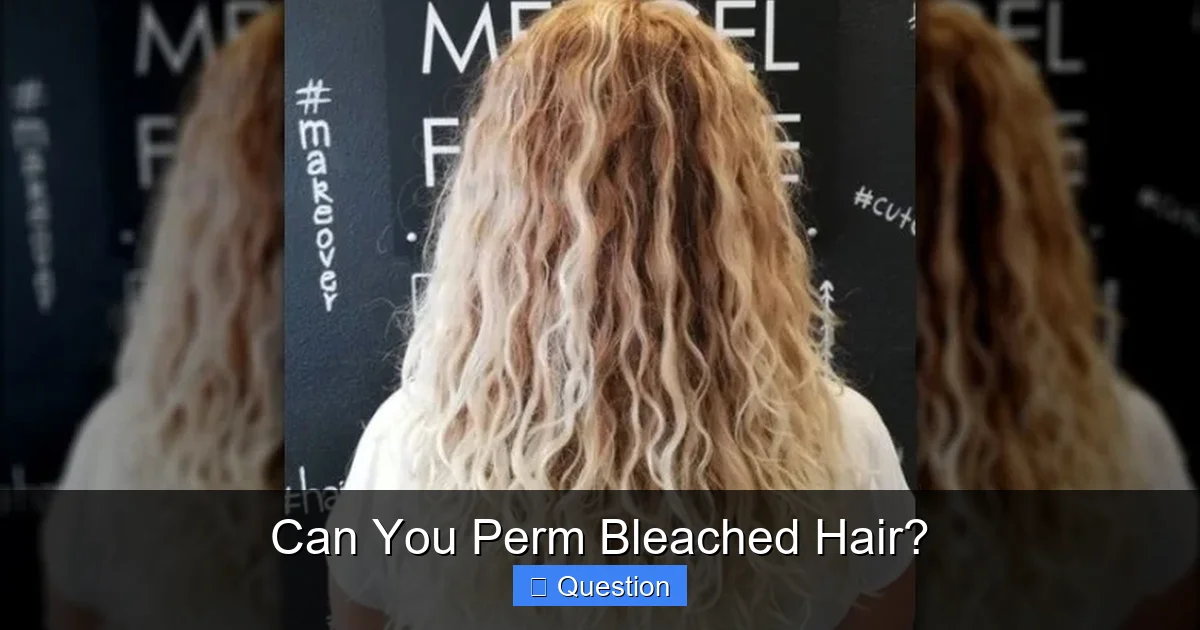
Perming bleached hair is a complex and risky endeavor, but it can be possible under very specific circumstances. Your hair must be in excellent health, and professional consultation, along with a crucial strand test, is absolutely non-negotiable. Attempting to perm damaged bleached hair can lead to severe breakage and irreversible harm.
You’ve gone blonde, enjoyed the bright transformation, and now perhaps you’re craving a new texture. Maybe you’re scrolling through social media, admiring those bouncy, voluminous curls, and a thought pops into your head: “Can I perm my bleached hair?” It’s a fantastic question, and one that many people ponder when considering a significant hair transformation.
The allure of a permanent wave on lightened locks is understandable. It promises a dramatic change, pairing a bold color with an exciting new shape. However, the journey to achieving this look on bleached hair is far from simple. It’s a path paved with potential risks and requires a deep understanding of hair science, careful planning, and, most importantly, professional expertise.
In this comprehensive guide, we’re going to dive deep into whether you can perm bleached hair, what precautions you need to take, and what to expect along the way. We’ll explore the science behind both bleaching and perming, the critical factors to consider, and how to ensure your hair stays as healthy as possible throughout the process. So, let’s unravel this curly conundrum together!
Key Takeaways
- Bleached Hair is Vulnerable: Bleaching significantly alters hair structure, making it weaker and more porous, and thus highly susceptible to further chemical damage from perming.
- Professional Assessment is Crucial: Never attempt to perm bleached hair yourself. A skilled stylist must assess your hair’s health, elasticity, and porosity before considering a perm.
- The Essential Strand Test: A strand test is paramount. It determines how your hair will react to the perm solution, revealing if it can withstand the process or if severe damage will occur.
- Excellent Hair Health is a Prerequisite: Only very healthy, minimally damaged bleached hair might be a candidate for perming. If your hair is brittle, dry, or elastic, it’s not suitable.
- Gentle Formulations and Timing: If a perm is deemed safe, a stylist will use specific, gentler perm solutions and precise timing to minimize stress on the hair.
- Intensive Aftercare is Mandatory: Post-perm, a rigorous routine of moisturizing, deep conditioning, and heat protection is vital to maintain hair health and the integrity of your curls.
- Consider Alternatives: If your hair isn’t a candidate, embrace heatless curling methods or temporary styling options to achieve a curly look without permanent chemical processing.
📑 Table of Contents
The Bleached Hair Dilemma: Understanding the Damage
Before we even think about adding another chemical process, it’s vital to understand what happens to your hair when it’s bleached. Bleaching isn’t just a simple color change; it’s a profound structural alteration that leaves your hair in a much more vulnerable state.
The Chemical Process of Bleaching
When you bleach your hair, an alkaline agent (like ammonia) opens up the hair’s cuticle layer. Then, an oxidizing agent (hydrogen peroxide) penetrates the hair shaft. Its job is to break down the melanin pigments that give your hair its natural color. While it’s busy lifting color, it also breaks down the hair’s fatty acids and some of its structural proteins, mainly keratin.
Structural Changes and Vulnerability
This process, by its very nature, causes damage. The cuticle, which acts as your hair’s protective outer layer, becomes rougher and more porous. The inner cortex, which provides strength and elasticity, is weakened. Think of your hair like a strong rope; bleaching essentially frays that rope. It becomes less elastic, more prone to breakage, dryness, and frizz. It also struggles to retain moisture.
When you consider adding a perm to this already compromised structure, you’re looking at introducing even more chemicals that aim to break and reform the disulfide bonds within the hair. These bonds are responsible for your hair’s shape. For hair that’s already been through the bleaching wringer, this can be a recipe for disaster if not handled with extreme care.
Can You Perm Bleached Hair? The Short Answer (and the Long One)
So, the million-dollar question: can you perm bleached hair? The short answer is: sometimes, but it’s incredibly risky and requires professional assessment. The long answer involves a lot of “ifs,” “buts,” and “only under these conditions.”
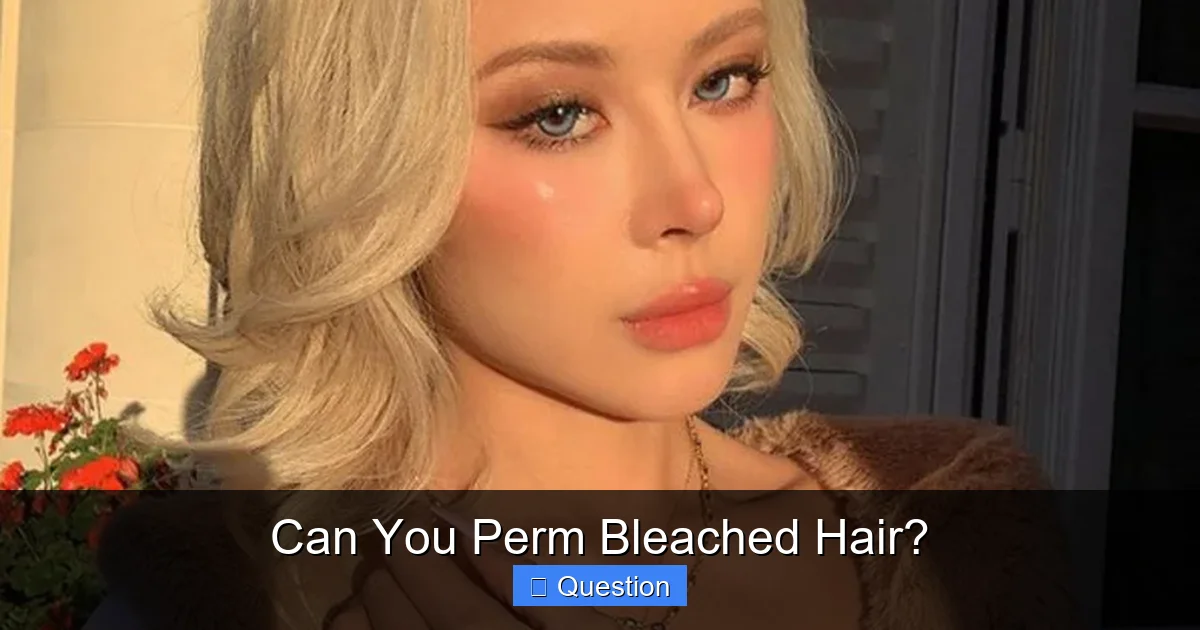
Visual guide about Can You Perm Bleached Hair?
Image source: thelist.com
Why It’s a Risky Business
Perming involves applying a chemical solution to break the hair’s disulfide bonds, wrapping the hair around rods, and then applying a neutralizer to reform those bonds into a new curly shape. For healthy, virgin hair, this is a standard process. For bleached hair, however, it’s like asking an already fragile rope to perform a heavy-duty task. The hair may simply not have enough integrity left to withstand the process.
- Increased Porosity: Bleached hair is more porous, meaning it absorbs chemicals much faster and less predictably. This can lead to over-processing in a very short amount of time.
- Loss of Elasticity: Healthy hair stretches and bounces back. Bleached hair often loses this elasticity, becoming brittle. If you try to perm hair that has no elasticity, it won’t hold the curl, or worse, it will break.
- Severe Breakage: The most significant risk is severe breakage. Your hair could become gummy, straw-like, or even dissolve if it’s over-processed during the perm. This damage is often irreversible.
- Unpredictable Results: Even if your hair survives, the perm might not take evenly, or the curls could be limp and frizzy instead of bouncy and defined.
The “Absolutely Not” Scenarios
There are definite situations where perming bleached hair is an absolute no-go, and any responsible stylist will tell you this upfront:
- Extremely Damaged Hair: If your bleached hair is already showing signs of significant damage—think excessive frizz, split ends, gummy texture when wet, or extreme dryness—do not perm it.
- Recent Bleaching: If you’ve just bleached your hair, it needs time to recover. Wait at least several weeks, ideally months, and focus on intensive conditioning.
- Multiple Bleaching Sessions: If your hair has undergone multiple bleaching sessions to achieve a very light blonde or platinum shade, it’s likely too compromised for a perm.
- Home Perm Kits: Never, ever attempt to perm bleached hair with a home perm kit. These kits are not formulated for delicate, chemically treated hair and lack the precision and expertise needed to minimize damage.
The Essential Pre-Perm Checklist for Bleached Hair
If, after reading all the risks, you’re still considering a perm for your bleached hair, then it’s time to get serious about preparation. This checklist is non-negotiable.
Professional Consultation is Non-Negotiable
This is step number one. Find a highly experienced stylist who specializes in perms and has a deep understanding of chemically treated hair. They will assess your hair’s current condition, history, and overall health. Be completely honest about your hair’s bleaching history and any other chemical treatments it has undergone.
A good stylist will be able to tell you if your hair can realistically withstand a perm. They might even advise against it, and if they do, listen to them. Their expertise is your best defense against disaster.
The All-Important Strand Test
This cannot be skipped. Before applying perm solution to your entire head, your stylist will perform a strand test. They will take a small, inconspicuous section of your hair (often from the back or underneath) and apply the perm solution to it.
The strand test reveals several crucial things:
- How your hair reacts to the perm chemicals.
- How long it takes for the perm to “take” without over-processing.
- The resulting curl pattern and integrity.
If the strand test results in breakage, excessive frizz, or a gummy texture, it’s a clear sign that your hair cannot handle a full perm, and the stylist will (and should) stop there.
Hair Health Assessment: Is Your Hair Ready?
Even with professional consultation, you can do some basic checks. Gently stretch a single strand of wet hair. If it stretches a bit and then springs back without breaking, that’s a good sign. If it snaps immediately, feels mushy, or stretches endlessly without returning to its original state, your hair is too compromised.
Also, look for signs of surface damage: excessive split ends, extreme dryness, or a dull, brittle appearance. If your hair doesn’t feel soft and relatively strong, it’s not ready to perm bleached hair.
Deep Conditioning Regimen
If your stylist gives a tentative green light, you’ll likely need to embark on an intensive conditioning regimen for several weeks, if not months, leading up to the perm. This means regular deep conditioning treatments, protein treatments (if recommended by your stylist), and avoiding heat styling. The goal is to strengthen your hair as much as possible to give it the best fighting chance.
The Perming Process for Bleached Hair: A Gentle Approach
If, after all the assessments and tests, your stylist determines your hair is healthy enough to proceed, the perming process itself will be handled with extreme care and precision, very differently than on virgin hair.
Choosing the Right Perm Solution
For bleached hair, your stylist will opt for a gentler perm solution. This might be an acid perm or a thio-free option, which are less harsh than traditional alkaline perms. These solutions work at a lower pH and are designed to minimize damage while still creating a curl. The specific solution chosen will depend entirely on your hair’s condition and the strand test results.
Sectioning and Rodding
The hair will be carefully sectioned and wrapped around perm rods. The size of the rods will determine the size and tightness of your curls. For bleached hair, stylists might choose slightly larger rods to create looser, softer waves, as tighter curls often require stronger solutions and more processing time.
Timing and Neutralization
This is where the strand test truly shines. The stylist will apply the perm solution and monitor it meticulously. The processing time for bleached hair is often significantly shorter than for virgin hair, due to its increased porosity. Every minute counts. The stylist will continuously check the hair for elasticity and curl formation to prevent over-processing. Once the desired curl is achieved, a neutralizer is applied. This step re-hardens the disulfide bonds in their new curly shape, locking in the perm.
Post-Perm Care: Protecting Your New Curls
Congratulations, your bleached hair has successfully been permed! But the work doesn’t stop here. Post-perm care is absolutely critical, especially for hair that has undergone multiple chemical treatments. Your hair will be delicate and thirsty for moisture and nutrients.
Gentle Washing and Conditioning
- Wait to Wash: Do not wash your hair for at least 48-72 hours after the perm. This allows the new bonds to fully set.
- Sulfate-Free Products: Use gentle, sulfate-free shampoos and conditioners specifically designed for curly and chemically treated hair. Sulfates can strip moisture and cause frizz.
- Cool Water Rinse: Rinse with cool water to help seal the cuticle and enhance shine.
Heat-Free Styling
- Air Dry Whenever Possible: Avoid heat styling as much as you can. Heat can further dry out and damage your already fragile curls.
- Diffuser on Low Heat: If you must use a blow dryer, use a diffuser attachment on the lowest heat and speed setting.
- Hands-Off Approach: Try not to touch your hair too much while it’s drying, as this can lead to frizz.
Regular Deep Treatments
Incorporate regular deep conditioning masks and leave-in conditioners into your routine. Look for products rich in protein (if your hair needs it) and moisturizing ingredients like argan oil, shea butter, and hyaluronic acid. These treatments will help repair, strengthen, and hydrate your hair, preventing dryness and breakage.
Avoid Further Chemical Treatments
Give your hair a long break from any further chemical processing, including color treatments. Your hair needs time to recover and strengthen. If you wish to color your hair again, consult your stylist and wait several months, focusing on intense hair health treatments in the interim.
Conclusion
So, can you perm bleached hair? The answer is a cautious “yes,” but it comes with a significant asterisk. It’s a high-stakes gamble that requires impeccable hair health, a highly skilled and experienced professional, and an unwavering commitment to diligent aftercare. The risks of severe damage, breakage, and unpredictable results are very real.
Before you commit, truly assess if the potential reward outweighs the risk. Be patient, be thorough in your research, and always prioritize the health of your hair above all else. If your stylist advises against it, trust their judgment. There are many beautiful ways to create curls and waves without resorting to permanent chemical treatments on already delicate hair. Ultimately, healthy, strong hair, whether straight or curly, is always the most beautiful.
Frequently Asked Questions
Is it ever truly safe to perm bleached hair?
While “safe” is a strong word for any chemical process on bleached hair, it can be done with minimal risk if your hair is in exceptional condition, has been assessed by a professional stylist, and passes a thorough strand test. It’s about damage mitigation, not elimination.
How long should I wait after bleaching before considering a perm?
It’s generally recommended to wait at least 4-6 weeks, but ideally several months, after bleaching before even contemplating a perm. This allows your hair time to recover and for you to intensively condition it.
What are the immediate signs of damage if I try to perm bleached hair and it goes wrong?
Immediate signs of damage can include hair feeling gummy or mushy when wet, becoming overly elastic and not bouncing back, extreme frizz, snapping or breaking off easily, or appearing severely dry and brittle.
Can I do a home perm on my bleached hair?
Absolutely not. Attempting a home perm on bleached hair is highly discouraged. Home perm kits are not formulated for chemically treated hair, and without professional expertise, you risk severe and irreversible damage.
Are there alternatives to perming if my bleached hair isn’t a candidate?
Yes, many! You can achieve beautiful curls and waves with heatless styling methods like flexi-rods, curlformers, or braids. Mousse, gels, and curl creams can also enhance natural texture or temporarily set curls without chemical processing.
How much more expensive is it to perm bleached hair compared to virgin hair?
The cost can be higher due to the specialized products (gentler solutions), the increased time, skill, and precision required from the stylist, and the extensive pre- and post-treatment necessary to minimize damage. Always get a detailed quote from your stylist.
As an Amazon Associate, We earn from qualifying purchases.